
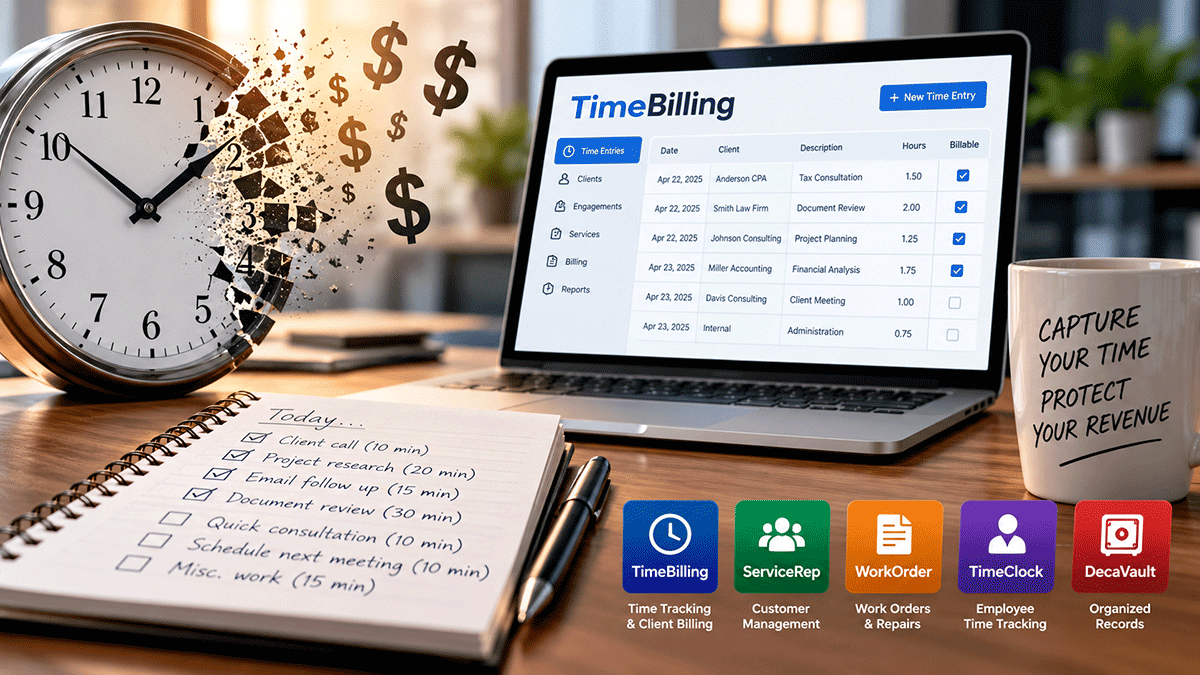
Are Unrecorded Billable Hours Costing Your Small Business Money?
Running a small business in Wilmington or the surrounding Cape Fear region means juggling customers, appointments, projects, and everyday administrative responsibilities. For independent consultants, accountants, attorneys, and other service professionals, one important task can easily get overlooked: keeping an accurate record of the time spent working for clients.
A quick phone call, an unexpected customer question, a few minutes reviewing documents, or additional work on a project may seem insignificant at the time. But when those activities go unrecorded, they can add up to lost billable hours and missed revenue.
The solution doesn’t have to involve complicated software or a major change in how you operate your business. Sometimes, it starts with a better way to capture the time you’re already spending.
The Small Tasks That Never Make It Onto an Invoice
Think about a typical day for a self-employed professional. You might begin with a scheduled client meeting, answer several emails, handle an unexpected telephone consultation, and spend part of the afternoon researching a customer’s problem.
Some activities are easy to remember because they occupy a large portion of the day. Others take only five or ten minutes and are quickly forgotten.
When billing records are prepared days or weeks later, those smaller activities may never be included.
Consider a professional who charges $100 per hour and overlooks just 15 minutes of billable work each business day. Over five days, that’s 75 minutes of potentially unbilled work. Over 48 working weeks, the total reaches 60 hours, representing $6,000 in potential revenue.
That’s a hypothetical example, not a guaranteed financial loss. Actual results depend on the type of work, billing arrangements, and whether the time would otherwise have been charged to the client.
Still, it illustrates why accurate time recording deserves attention.
Why Rebuilding Timesheets From Memory Doesn’t Work Well
Many small business owners rely on handwritten notes, spreadsheets, calendar appointments, or memory to prepare their billing records.
That approach may work reasonably well when there are only a few customers and projects. But as the workload increases, remembering every activity becomes more difficult.
By Friday afternoon, can you accurately remember how much time you spent answering a client’s questions on Tuesday? What about the extra research you performed Wednesday morning or the follow-up call that interrupted another project?
The longer you wait to record the work, the greater the opportunity for mistakes and omissions.
A more dependable approach is to capture time as the work happens, even if you organize the billing details later.
A Simpler Approach With TimeBilling

TimeBilling, developed by Rock Local Media Group, Inc., is a progressive web application designed for independent professionals and small businesses that need to record client work and maintain organized billing information.
One of its practical features is the ability to start recording time without first selecting a client, engagement, service, or billing rate.
This matters when you’re interrupted by an unexpected customer request. Instead of stopping to complete several administrative fields, you can begin recording the time and return your attention to the work.
Afterward, the recorded activity can be assigned to the appropriate client and engagement, with service information, billing rates, and notes added as needed.
TimeBilling also supports billable and non-billable service classifications, helping professionals maintain a clearer record of how their working hours are spent.
Who Can Benefit From Better Time Tracking?
Although different professions have different billing practices, the need to maintain accurate records is common across many service businesses.
Independent Consultants
Business consultants often divide their days among client meetings, research, planning, telephone calls, and project-related activities. Recording these activities helps maintain accurate billing records and provides insight into the actual time required for each engagement.
Accounting and Bookkeeping Professionals
Accountants and bookkeepers may handle recurring services, tax preparation, client consultations, and special projects. Even when services are billed at a fixed price, understanding the time involved can help evaluate whether those fees adequately reflect the work performed.
Attorneys and Small Law Practices
Legal professionals frequently work on several matters during the same day. Maintaining organized time records helps document client-related activities and supports accurate billing where hourly arrangements apply.
Freelancers and Other Professional Service Providers
Designers, technical consultants, independent contractors, and other professionals can benefit from knowing how much time individual customers and projects require.
Better records can also make it easier to estimate future work and identify projects that consistently take longer than expected.
Billable Hours Aren’t the Only Hours Worth Tracking
Even when a business doesn’t charge customers by the hour, understanding how time is spent can be valuable.
Administrative work, marketing, internal meetings, and customer support all require time. These activities may not generate a separate invoice, but they affect the cost of operating the business.
For example, a consultant who charges a fixed project fee may discover that a particular type of engagement consistently requires more hours than anticipated.
That information can help the consultant evaluate pricing, improve estimates, or adjust the way future projects are managed.
Tracking time isn’t simply about charging customers more. It’s about understanding the work required to operate a profitable business.
Other Everyday Business Problems Deserve Simple Solutions
Time tracking is only one of the administrative challenges facing small businesses.
A repair shop may struggle to keep work orders organized. A field service company may need better customer and service records. An employer may need a straightforward way to track employee working hours.
Rock Local Media Group addresses these different requirements through its Local Service Rep family of business applications.
- TimeBilling: Records professional time and organizes client billing information.
- ServiceRep: Helps service businesses organize customers, service locations, and related operational records.
- WorkOrder: Supports the creation, assignment, and tracking of service and repair work orders.
- TimeClock: Provides employee working-hour tracking for small businesses.
- DecaVault: Helps organize important personal and business information through structured recordkeeping applications.
Each application addresses a particular need rather than assuming every small business requires a large, complicated management system.
Practical Examples From Different Industries
Local Service Rep has also published a collection of illustrative business case studies examining common administrative challenges across several industries.
These include accounting firms, law practices, business consultants, appliance repair shops, mobile service providers, and other small operations.
The studies describe realistic business situations and demonstrate how organized workflows and focused software can help address everyday recordkeeping problems. They are educational scenarios rather than documented customer testimonials.
For examples related to professional time tracking and client billing, explore the Business Consulting Firm Case Study, CPA and Accounting Firm Case Study, and Law Firm Business Case Study.
Make Every Working Hour Accountable
For Wilmington-area professionals and small business owners, improving profitability doesn’t always require finding more customers or working longer hours.
Sometimes, the first opportunity is to make better use of the work already being performed.
Recording time consistently, maintaining organized client information, and reviewing how hours are spent can help reduce billing omissions and improve business decisions.
TimeBilling offers a focused approach to these challenges without requiring an extensive business management platform.
Learn more: Visit TimeBilling to explore its features and 14-day free trial. The application is available for $24.95 per month.
For additional small business management applications, visit Local Service Rep, developed by Rock Local Media Group, Inc.
Explore Our Software Solutions
Local Service Rep offers practical, affordable software designed to simplify everyday business operations. Explore our solutions:
- ServiceRep – Service business management.
- WorkOrder – Work order and repair management.
- TimeBilling – Time tracking and client billing.
- TimeClock – Employee time tracking.
- DecaVault – Personal information and record management.
Developed by Rock Local Media Group, Inc.